Wheelie Master: Moto Ride 3D
Wayfu Game StudioRacing
4.5272.00 Reviews
- Version
- 1.49
- Installs
- 10.00M
- Age Rating
- Everyone
Screenshots
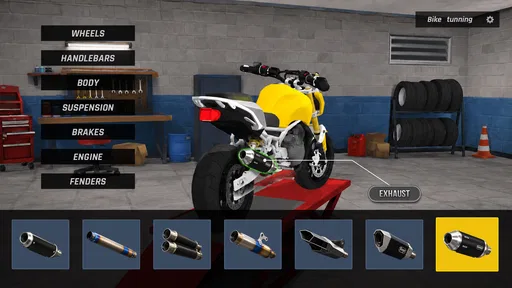
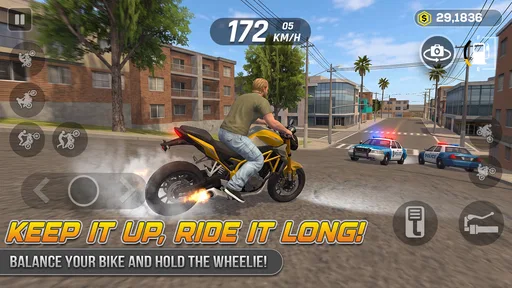
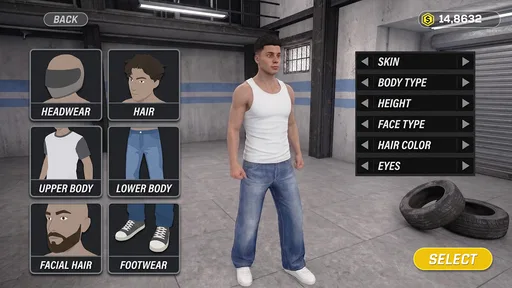
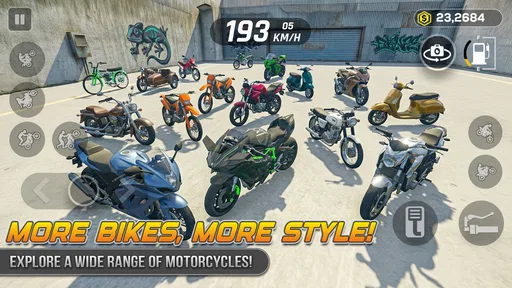
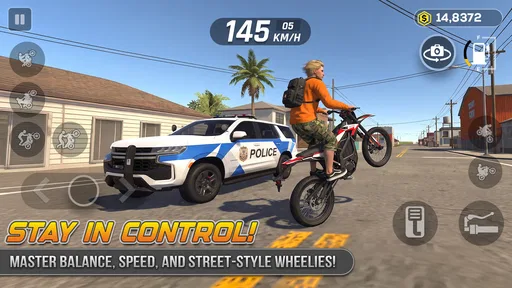
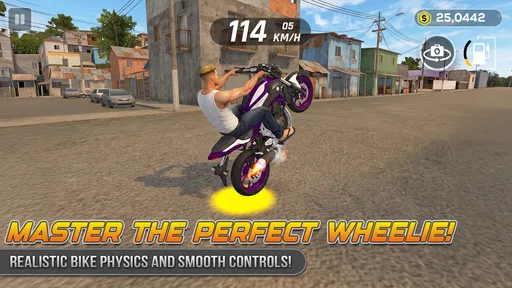
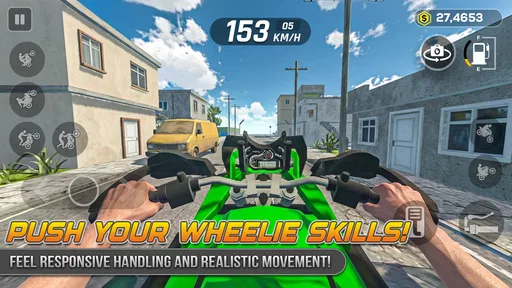
Our Review of Wheelie Master: Moto Ride 3D
 Analysis by Appyee
Wheelie Master: Moto Ride 3D is a free racing game built around one clear idea: keeping a motorcycle balanced while moving through city traffic. I found the appeal immediate because the central action is easy to understand, yet demanding enough to make each attempt feel like a small personal challenge. Wayfu Game Studio has kept the concept focused rather than turning it into a broad motorcycle simulator, so this is best approached as a quick, skill-based arcade game for short sessions.
The game is aimed at Everyone, which fits its simple presentation and straightforward premise. It has attracted over ten million installs and holds a 4.5 average from around twenty-seven thousand ratings, giving it a strong audience beyond the first few curious downloads. That popularity does not automatically make it perfect, but it does suggest that the basic wheelie format works for many players. My own recommendation is cautious but positive: try it if you enjoy timing, balance, and repeat attempts, but do not expect the depth of a full motorcycle racing title.
How the wheelie-focused racing works in practice
The main pleasure comes from managing the motorcycle rather than simply steering around a track. A normal race often rewards speed as the dominant goal; here, speed only matters if you can keep the front wheel raised without losing control. That changes the rhythm. I found myself watching the bike’s angle, preparing for traffic, and deciding whether to maintain a risky position or settle down before the next obstacle.
This makes the game approachable for someone who has never played a motorcycle racer. You do not need to learn a large collection of vehicle settings before starting. The challenge is visible on the screen and understandable through play: hold the wheelie, react to the road, and avoid turning confidence into an overcorrection. The simplicity is a strength during a short break, especially when I wanted something I could begin without reading a long tutorial.
At the same time, the narrow focus can become a limitation. Players who want several racing disciplines, detailed bike customization, realistic handling, or long championship campaigns may find the experience too concentrated. This is not the kind of game I would choose for a serious simulation mood. It is closer to an arcade reflex test with a motorcycle theme, and it works best when that expectation is clear from the start.
Why city traffic changes the challenge
Traffic gives the wheelie mechanic a practical reason to exist. Keeping the front wheel up is not only about showing off; it also becomes a timing problem as the road fills your attention. I had to think beyond the next second, because an obstacle can punish a careless continuation even when the wheelie itself feels stable. That combination creates a useful tension between playing safely and chasing a more satisfying run.
A good everyday use case is a short commute or a few minutes waiting for an appointment. I would open it when I wanted interaction rather than passive scrolling, but did not have the time or concentration for a large open-world game. One or two failed attempts do not require much emotional investment, and a successful sequence feels rewarding without demanding a full evening.
For better control, I recommend treating every run as a lesson in moderation. New players often focus only on raising the front wheel, but the more important habit is learning when to reduce the angle. I found that gentle corrections are more reliable than dramatic reactions. When traffic appears, it is tempting to keep chasing the longest possible wheelie; in practice, protecting the run can be more satisfying than throwing it away for a moment of extra style.
Progress feels tied to personal consistency
The most meaningful progress here is not necessarily unlocking a huge collection of content. It is improving your ability to repeat a controlled action under pressure. That distinction matters when deciding whether the game will hold your attention. If you enjoy beating your own performance and refining timing, the compact design can stay interesting. If you need constant new environments or a long-term narrative, the same design may feel repetitive sooner.
I also noticed that this type of game can create a mild pressure loop. A near-success makes another attempt feel reasonable, while a mistake caused by overconfidence invites an immediate retry. That is enjoyable when I set a stopping point, but less comfortable when I keep playing simply because the previous run ended badly. My practical advice is to decide before starting whether you are playing for a few attempts or for a longer session, then close the game when the challenge stops feeling fun.
The current version is 1.43, and the game was released on June 11, 2025. Those details are useful when checking compatibility and deciding whether the title is relatively current for your device. It supports Android 7.1 or later, which makes it accessible to many older Android phones as well as newer models. Still, compatibility does not guarantee identical comfort: a smaller screen may make traffic and balance cues harder to read, while a larger display can make the action easier to follow.
Spending, pressure, and what can be judged fairly
The download is free, and listed in-app purchases range from $3.99 to $4.99 per item. That gives me a clear starting point for the spending question: you can try the core experience without paying upfront, while optional purchases sit in a modestly priced range. I would still recommend checking each purchase screen carefully before confirming anything, especially if you are handing the phone to a child.
What matters most is not the existence of purchases by itself, but whether the game makes progress feel uncomfortable without them. From a reviewer’s perspective, I can fairly discuss the price range and the free entry point, but I should not claim that purchases are required, cosmetic, or tied to a particular advantage without evidence in the game. My sensible approach is to play first, decide whether the wheelie challenge is genuinely enjoyable, and only then consider spending.
For me, the strongest protection against unnecessary spending is to judge the game by its free experience before becoming invested in a long session. If the basic traffic runs already provide enough challenge, there is no reason to buy anything simply because a purchase is presented. If the free progression starts to feel like a chore, that is a sign to pause rather than assume payment will solve the underlying issue.
Parents should also treat the Everyone rating and the purchase range as separate pieces of information. The age rating describes suitability of content, not a guarantee that a child will understand purchase prompts or resist them. I would use the device’s purchase controls and supervise the first sessions. That is ordinary good practice for any free game with paid items, and it is especially useful when the game’s quick retry structure encourages repeated play.
Is the competition fair?
Wheelie Master: Moto Ride 3D makes the most sense to me as a personal skill game rather than a title I would choose for serious competitive ranking. The central contest is between my timing and the road’s demands. That is a positive kind of fairness: improvement comes from learning how to balance and react, not from pretending that a complicated control system is necessary.
However, I would avoid assuming that every player has exactly the same experience simply because the premise is simple. Device size, touch responsiveness, performance, and visibility can all affect how comfortable a balance-focused game feels. That does not prove an unfair system, but it is a reason to compare your own experience rather than judge performance only by someone else’s results.
Compared with conventional racing games, this title also reduces the importance of vehicle statistics and track knowledge. A traditional racer may reward choosing the best car, tuning settings, memorizing corners, or managing a long race. Here, the distinctive skill is maintaining a wheelie through traffic. That makes it more immediately understandable, but also less suitable for players who want strategic team building, realistic competition, or a broad selection of race formats.
If I wanted a deep competitive racing experience, I would look elsewhere. I would choose a larger racing game for structured events, detailed vehicle choices, or a more conventional sense of progression. I would choose this one when I wanted a focused test of control that could be understood within minutes. The trade-off is clear: less breadth in exchange for a quicker, more unusual challenge.
Small decisions that improve a session
One useful habit is to separate control practice from score chasing. During the first few attempts, I pay attention to how much correction the bike needs and how traffic changes my timing. I do not immediately treat every run as a record attempt. This makes mistakes informative instead of frustrating, and it helps reveal whether the game’s handling feels comfortable on my particular phone.
Another practical tip is to play with a clean visual field. Notifications, overlays, and a crowded grip can make a timing game feel harder for reasons unrelated to skill. I prefer holding the phone steadily and avoiding distractions, especially when I am trying to learn the point at which a wheelie becomes unsafe. That may sound minor, but in a game built around immediate reactions, attention is part of the control system.
I also recommend using short personal goals. Rather than continuing until a run becomes stressful, I might aim to survive one difficult traffic sequence, maintain control after a correction, or finish a session without making the same mistake twice. These goals create variety inside the same basic mechanic and are more useful than endlessly repeating a failed gesture.
Finally, pay attention to the difference between a difficult challenge and a tired player. Because attempts are quick, it is easy to blame the game when concentration has simply dropped. If my corrections become increasingly frantic, I stop for a while. This is one of the few racing games where a brief pause can improve the next run more than immediately trying again.
Who should download it, and who should skip it?
I think the game is a good match for players who enjoy arcade racing, motorcycle stunts, and skill loops based on timing. It is also suitable for someone who wants a free title that can be sampled quickly before deciding whether it deserves regular play. The city-traffic setting gives the simple wheelie idea enough context to feel more active than a static balance exercise.
I would be less likely to recommend it to someone seeking a realistic motorcycle simulator. The focus is not on learning real riding technique, planning fuel, managing a detailed machine, or completing a long professional racing calendar. I would also suggest caution for players who dislike repeating similar attempts, because the satisfaction depends heavily on improving within a focused format.
It may not be the best choice for a child who can make purchases without supervision, even though the content rating is Everyone. The free price is convenient, but free-to-start games still deserve the same attention to spending controls as any other app. For adults, the decision is simpler: install it, test whether the wheelie-and-traffic loop feels satisfying, and keep it only if the challenge remains enjoyable after the novelty fades.
What I would want to know before installing
Will it work on an older Android phone? The stated minimum is Android 7.1, so the software requirement is not limited to recent devices. I would still judge the experience by actual responsiveness and screen comfort, since precise balance depends on controls feeling immediate. A compatible phone can run the game while still offering a less pleasant session than a newer device.
Do I need to pay to try it? No upfront price is listed, and the game is free to download. Paid items are listed between $3.99 and $4.99 each. I would therefore begin without spending, explore the basic challenge, and make a deliberate decision later rather than treating a purchase as part of the installation process.
Is it suitable for casual play? Yes, that is where I think it fits best. The wheelie mechanic is easy to understand, and the traffic creates compact moments of risk. It can occupy a short break, although players who become absorbed in retrying should set their own limit so that a quick game does not turn into an unwanted time sink.
Does it replace a full racing game? In my view, no. It offers a different kind of satisfaction: balance, reaction, and the desire to make one cleaner run. Choose a conventional racer if you want broad content and structured competition; choose this game if a focused stunt challenge sounds more appealing than a complete racing career.
Can I judge the purchase system as fair? I can judge the free entry point and the stated item range, but I would not make stronger claims about how purchases affect progress without seeing the exact offers in context. My trust test is simple: enjoy the free loop first, read each prompt, and never buy merely to escape frustration created by a failed attempt.
My final view after weighing the trade-offs
The best reason to try this game is its focused wheelie challenge, not the promise of a complete racing world. I like that the premise can be understood immediately while still asking for patience and controlled reactions. City traffic gives each run a useful sense of danger, and the free entry point makes experimentation easy.
Its weaknesses are closely connected to its strengths. The narrow design may become repetitive for players who need constant variety, and it does not offer the same kind of depth as a conventional motorcycle racer. The presence of paid items means I would keep spending deliberate, particularly for younger players, but the listed purchase range is clear enough to support an informed choice.
Wayfu Game Studio has created a game I would recommend in the right situation: a short-session racing experience for someone who enjoys improving through repetition and wants a motorcycle game with an unusual central skill. I would skip it if I were looking for realism, a large campaign, or serious competitive structure. For everyone else, my advice is to download it free, test the traffic-and-balance loop on your device, and decide based on whether the next attempt feels exciting rather than obligatory.
Privacy and Permissions
See what permissions an app requests and how it handles your data.
- Wi-Fi connection information
- view Wi-Fi connections
- Other
- view network connections, full network access, control vibration, prevent device from sleeping, Google Play license check
Verdict
Strengths of Wheelie Master: Moto Ride 3D
- Simple controls make it easy for beginners to start riding.
- Short stunt sessions work well for quick gameplay breaks.,3D bike physics make wheelie timing feel engaging.
- Different bikes add variety as you progress.
- Offline play is convenient when no internet is available.
Limitations of Wheelie Master: Moto Ride 3D
- Ads may interrupt gameplay and affect the overall flow.
- Progress can feel repetitive after mastering the main tracks.
- Some bikes or upgrades may require extensive grinding.
- Physics occasionally feel inconsistent during landings.
- Limited customization reduces long-term appeal for some players.
Similar Picks in This Category
View All
Hill Climb Racing
Fingersoft4.3

Dr. Driving
SUD Inc.4.2

Traffic Rider
skgames4.5

Asphalt 8 - Car Racing Game
Gameloft SE4.6

Race Master 3D: Car Racing
Beresnev Games4.6

Extreme Car Driving Simulator
AxesInMotion Racing4.3
Frequently Asked Questions
What is Wheelie Master: Moto Ride 3D?
Wheelie Master: Moto Ride 3D is an arcade-style motorcycle game focused on performing long wheelies while maintaining balance. You control the rider, accelerate through different tracks, and try to avoid crashes, obstacles, and uneven landings. The gameplay is easy to understand, but reaching high scores requires careful throttle control, timing, and practice as the bike becomes harder to manage at greater speeds.
How do you play Wheelie Master: Moto Ride 3D?
The main objective is to lift the motorcycle’s front wheel and keep it in the air for as long as possible without tipping backward or landing badly. Players generally use simple touch or tap controls to accelerate and adjust the bike’s balance. Successful runs depend on making small, controlled movements rather than holding the controls continuously, especially when approaching ramps or obstacles.
Is Wheelie Master: Moto Ride 3D suitable for beginners?
Yes, the game is accessible to beginners because its controls and basic objective are straightforward. However, the physics can take some time to master. New players may crash frequently while learning how much acceleration to use and how to recover from an unstable wheelie. Short play sessions, repeated attempts, and gradual movements make the learning process much easier.
Does Wheelie Master: Moto Ride 3D require an internet connection?
The core riding experience is generally designed for quick, casual play and may work without a constant internet connection, depending on the version installed and the device platform. An internet connection can still be required for advertisements, updates, cloud features, or other online content. It is best to check the store listing and test the game offline after installation.
Are there advertisements or in-app purchases in Wheelie Master: Moto Ride 3D?
Like many free-to-download mobile arcade games, Wheelie Master: Moto Ride 3D may include advertisements and could offer optional purchases, such as removing ads, unlocking motorcycles, or obtaining virtual rewards. The exact options can vary between Android and iOS versions and may change after updates. Review the store’s pricing information before downloading, particularly if children will use the device.
Play our best games!


